How to Identify a Real Banarasi Saree — The Complete Authentication Guide
Five tests every buyer should know before spending ₹8,000 on a saree that might be powerloom. From burn tests to reading the weave — this is the guide we wish existed when we started buying handloom.

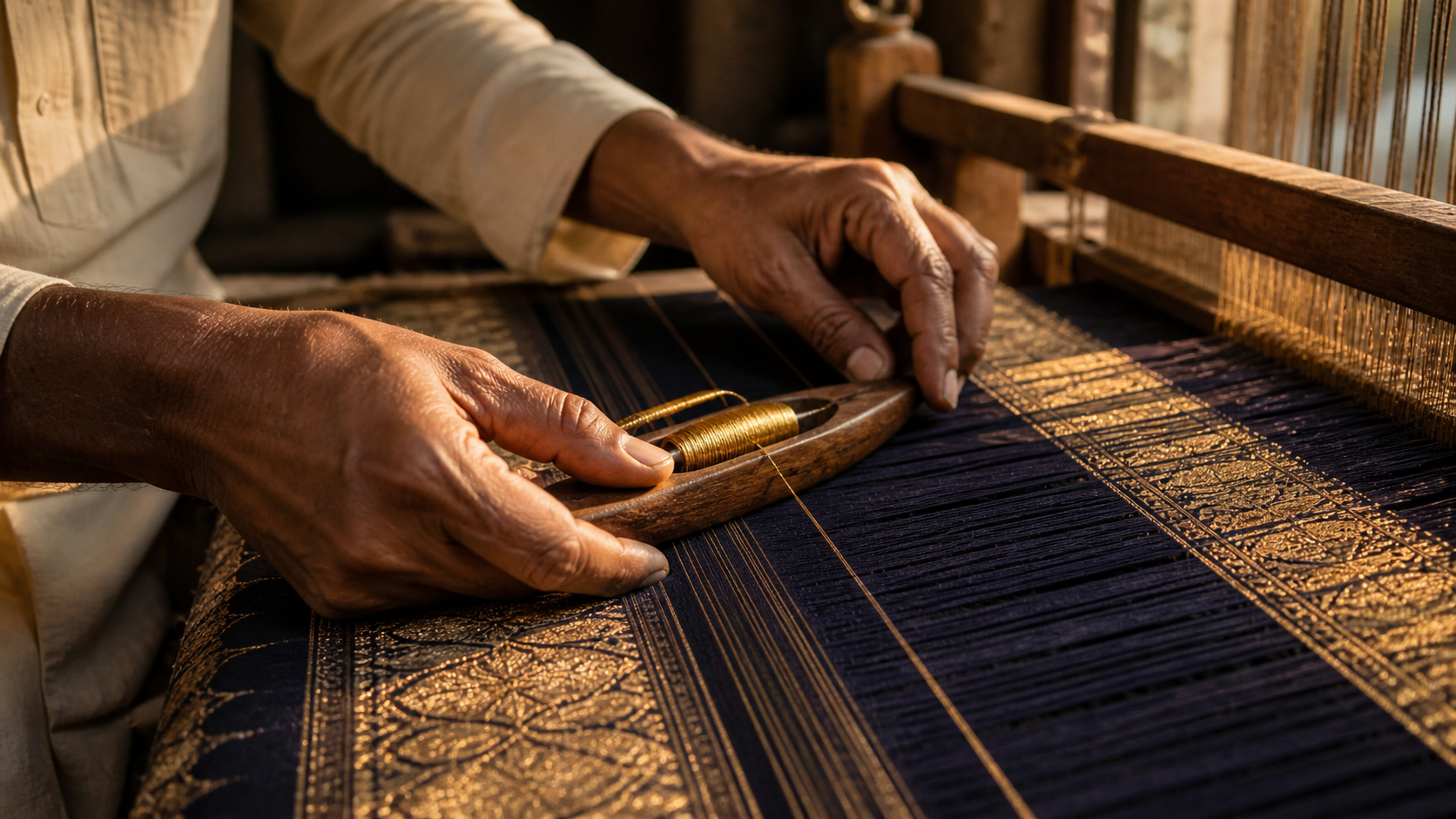
Varanasi has been weaving silk sarees for over a thousand years. The pit loom, the interlocked warp, the zari shuttle moving across thousands of threads — it is one of the oldest living textile traditions on earth. And yet the majority of sarees sold as “Banarasi” online are not handwoven in Varanasi at all.
They are powerloom sarees produced in Surat, Mumbai, or China, finished to look like the real thing, and sold — sometimes honestly as “Banarasi-style,” often dishonestly as “authentic Banarasi handloom” — for a fraction of the price it would cost to weave a genuine piece.
This guide exists because we are based in Varanasi. We know the weavers, we know the lanes, we know what real Banarasi silk feels like in your hands before it's been cut and hemmed and packaged in tissue. What follows are the exact checks a knowledgeable buyer in Madanpura would make — and that you can make, wherever you are.
If someone tells you a saree is pure Banarasi silk handloom and the price is under ₹3,000 — something is wrong. Understanding why is the most valuable thing this guide can give you.
What makes a Banarasi saree authentic?
An authentic Banarasi saree has three defining characteristics: it is woven on a handloom in the Varanasi district of Uttar Pradesh, using real silk warp threads interlocked with pattern wefts — often incorporating zari. That's it. No dye formula, no finishing technique, no regional aesthetic makes a Banarasi — only the loom, the location, and the silk.
Everything else — the motifs (kadwa, cutwork, jangla, butidar), the ground fabric type, the colour — is an aesthetic choice by the weaver. A Banarasi can be plain ivory or richly brocaded in gold. Both are authentic. A powerloom copy of either is not.
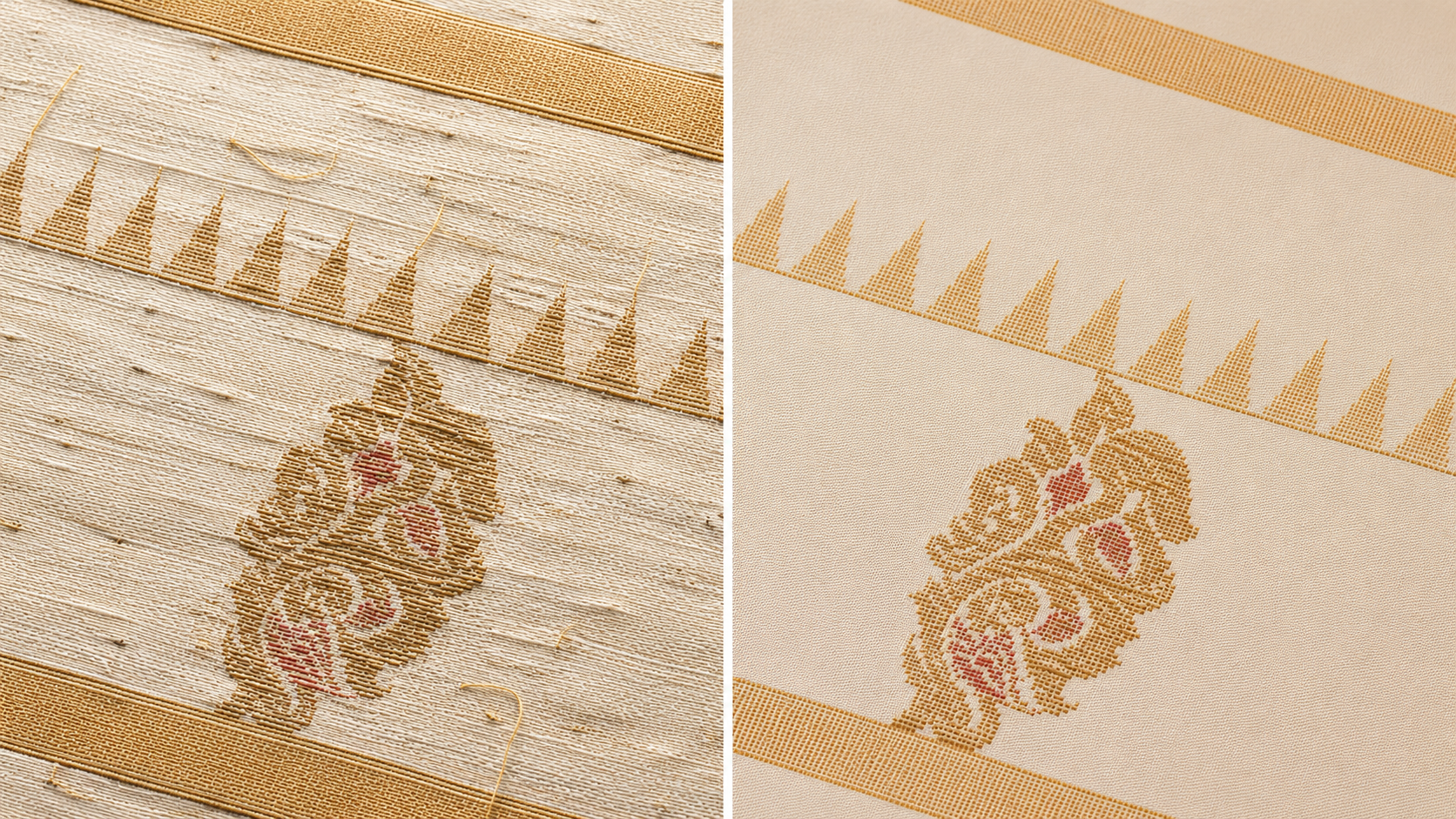
The five authentication tests
These tests require no specialist knowledge. They work in a shop, at a fair, and — with practice — even when buying online from detailed photographs. Do them in this order: each one builds on what the last told you.
Hold the saree loosely in your palm and let it fall. Real Banarasi katan silk has a cool, substantial weight — it falls with authority. Now run it through a closed fist.
Try passing the saree through a loose finger ring. Pure silk — even a full saree — can be gathered and pulled through. Synthetics bunch and resist.
Pull a few threads from the inner border. Burn them. Real silk burns slowly, smells like burned hair, and leaves a crushable ash.
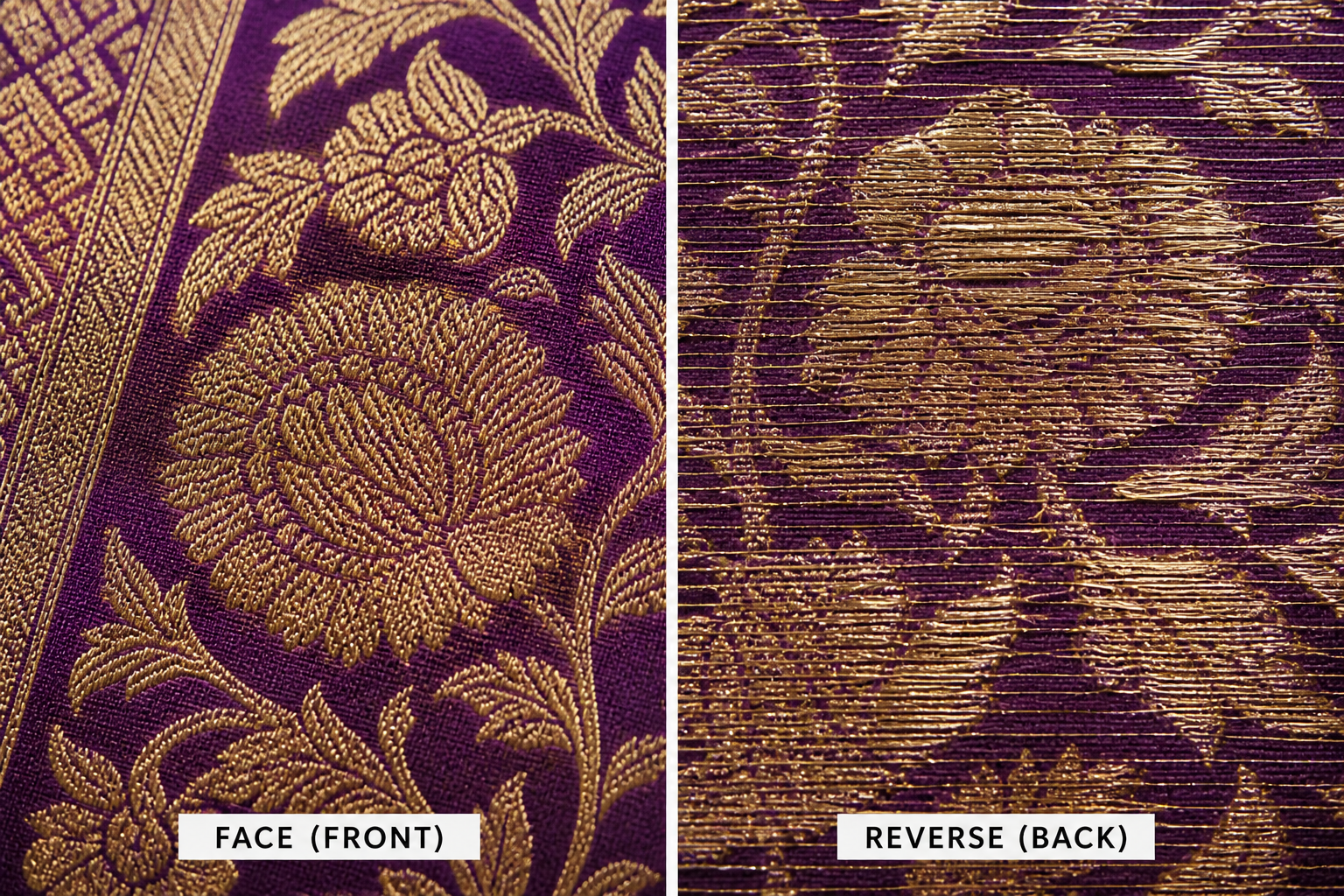
Turn the saree over. Authentic Banarasi handloom has floating threads across the back where the zari pattern sits. Powerloom copies have a flat, uniform back.
Rub the zari border against the inside of your wrist firmly. Pure zari — silver wire wrapped in gold — leaves no mark.
A note on the burn test
The burn test is the most definitive — and the hardest to do in a shop. You can ask a seller for a few cut threads from the border; a confident, legitimate seller usually obliges, because they know what the result will be. If a seller refuses, that itself is information worth having.
Understanding the price: what a real Banarasi should cost
The economics of handloom weaving are not forgiving. A single Banarasi katan silk saree — plain, no heavy zari — takes a master weaver two to three weeks of full-time work. A heavily brocaded jangla or meenakari piece can take two months. The raw silk alone, at Varanasi market prices, costs ₹800–₹1,500 per metre.
| Saree type | Typical authentic price | Red flag if under | What makes it cost more |
|---|---|---|---|
| Katan silk — plain/simple | ₹6,000–₹14,000 | ₹4,000 | Silk quality, weave density |
| Katan with zari border | ₹10,000–₹25,000 | ₹7,000 | Real vs imitation zari, border complexity |
| Katan butidar (allover brocade) | ₹15,000–₹40,000 | ₹10,000 | Number of weft colours, motif complexity |
| Jangla (dense overall weave) | ₹30,000–₹80,000 | ₹20,000 | Months of work, master weaver |
| Shikargah / Meenakari | ₹40,000–₹1,50,000+ | ₹30,000 | Multi-coloured zari, heritage design |
Where to buy authentic Banarasi sarees
The safest purchase is always directly from a weaver or weaver cooperative in Varanasi. The second safest is a government-certified source. Both exist online and offline.
Government and certified sources
UP Handloom Corporation showrooms and their online platform carry GI-tagged Banarasi sarees with verified provenance. NHDC and state emporiums are also reliable. Look for the Handloom Mark on the label — certification that the piece was made on a handloom.
Varanasi's weaving lanes
Madanpura, Lallapura and Peeli Kothi are the historic weaving neighbourhoods. Buying directly from a weaver-owned workshop here — where you can see the loom — is the gold standard.
Online: what to look for
Look for the seller's actual address, detailed photographs of the reverse side, the exact silk type named (katan, georgette, organza — not just “pure silk”), and a price that makes sense for the work described. A detailed, confident product description is a trust signal. Vague superlatives are not.
Everything in this guide, condensed into a one-page Saree Authenticity Checklist you can pull up on your phone in any shop. Free for Nakshapatta readers.